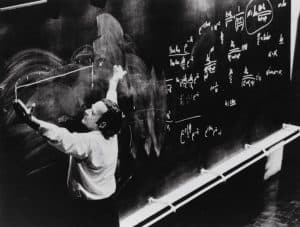
Perhaps Mr. Feynman would say it is that much.
Abstraction is one of those concepts that make so much sense that it is kind of scary how late through life I learned about it. But, I think, at essence, there is a complex, unanswerable question about it that even I if was born with the knowledge of abstraction levels I would still be lost, looking for answers: What is the lowest, most fundamental level of abstraction?
Perhaps it is the sum of our perceptions of world, but even that, by itself, is an abstraction of the world itself. Perhaps it is the world itself, but the world only has abstraction and its levels because humans give meaning to things. This relation is circular and nor the first nor the second propositions are satisfactory answers to me.
The most satisfactory answer I found was that the lowest level of abstraction is the first concept transmitted from one person to another, using language, drawings and writing, given that is the oldest provable sense of abstracting observed phenomena X into representation Y, therefore abstracting something that had no common meaning before then.
Moving from this instance of what is the lowest level of abstraction, I think we should think on the opposite side of the spectrum: What is the highest, least fundamental level of abstraction?
AI's impact
Perhaps reproduction without understanding is one of the highest levels of abstraction, given that you are usually the furthest from the most essential parts of the problem, or the so called first principles of the problem, given that you don't even understand the given level of it, you are moving away from its breaking down and you are moving towards the solution itself, without understanding the path to it, which is itself a reconstruct process derived from a deconstruct process of the problem into its smaller parts. I say usually because sometimes the given reproduction is, by itself, the ideal solution, but that is not the usual case for the most complex problems which have a higher layer count with a higher problem leaf count as well.
AI has bumped the count of reproductions without understanding to an unprecedented level, and perhaps even creating a new level of abstraction, given that it is not even able to understand the problem itself, but it can still produce a solution, which is itself a reproduction without understanding, but at an even higher level of abstraction with even higher confidence rates.
And to be honest, AI itself is at a level of abstraction too high for humans to understand why it works: How come you dump some many patterns of human language into a statistical model and it starts to produce coherent, logical, and even creative outputs? Despite this, people still insist to say that AI inhibits creativity.
Creativity vs AI
Have we discovered everything we can discover, thinking in the first level of abstraction of reality: everything that is natural by itself which is within our current range? No, we have not, but we have probably exhausted most of the things within our reach. And to be honest, coming from a Socrates POV: We probably don't know about things that we need that have not been discovered yet. Perhaps we know the purpose of some of them, but there's probably many things that we don't know why we need them yet.
Given this exhaustion, humans have found a way to compose and derive things from these first layer elements, creating, essentially, permutations of these elements into new elements which are then recursively permuted into even newer elements. This process, by itself, ends up reducing the ability of innovation for every single new combination made, and therefore, we can infer that most, or all of the innovation we see today is just a permutation of these first layer elements, which are themselves permutations of even more fundamental elements. That means that almost nothing is truly new, but rather a new combination of old things. And what is AI if not a tool that can reproduce element X, therefore its parts and element Y, therefore its parts, combined with the human being which can then pick and dissect the useful parts of these combinations and create something new?